Is 360Hz Gaming Worth It? Complete Cost-Benefit Analysis for Gamers in 2025
Honest analysis of 360Hz gaming value. Compare costs, diminishing returns, and find out if YOU need 360Hz or if 240Hz is sufficient.
Introduction
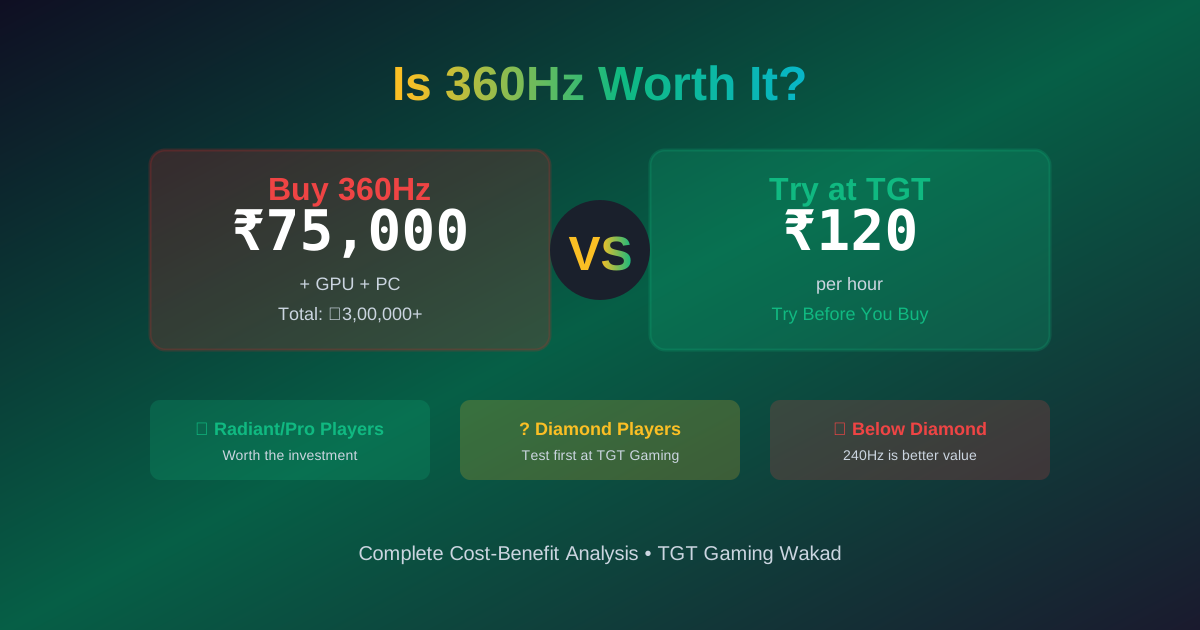
The jump from 240Hz to 360Hz sounds impressive on paper. But is that extra 120Hz jump actually worth dropping ₹75,000+ on a gaming monitor when you already have options? This question keeps gamers awake at night, especially competitive players trying to squeeze every advantage.
Here’s the honest truth: 360Hz is genuinely fast, but the value proposition depends almost entirely on WHO you are and WHAT you play. For some players, it’s a life-changing investment. For others, it’s expensive overkill that leaves their GPU struggling to even deliver those frame rates.
We’re breaking down the real math behind 360Hz gaming—the actual costs, diminishing returns, and when it genuinely matters. Plus, we’ll show you how to test both 240Hz and 360Hz side-by-side before spending a single rupee.
The Real Cost: 360Hz Home Setup vs Gaming Cafe Experience
Let’s talk money first, because it’s the biggest barrier to entry.
Full 360Hz Home Setup Investment:
- 360Hz Monitor: ₹50,000–80,000
- RTX 4070 Super/RTX 4070 Ti (minimum for consistent 360fps): ₹55,000–85,000
- Quality CPU (i7-14700K or better): ₹35,000–50,000
- Peripherals (mouse, keyboard, mousepad): ₹15,000–25,000
- Total: ₹155,000–240,000+
360Hz Experience at TGT Gaming:
- ₹120/hour for professional 360Hz setup
- All hardware already optimized
- Try both 240Hz and 360Hz monitors simultaneously
- Cost for informed decision: ₹600–1,200 for 5-10 hour sessions
Here’s what this means: You can experience 360Hz gaming for the cost of lunch—test whether you can actually perceive the difference, whether your GPU maintains those frame rates, and whether the investment genuinely improves YOUR gameplay.
Understanding Diminishing Returns: 60Hz → 360Hz
The jump from 60Hz to 120Hz feels revolutionary. You’ve probably experienced this yourself.
The jump from 120Hz to 240Hz feels significant—noticeably smoother.
The jump from 240Hz to 360Hz? It’s real, but subtle. Your brain processes the improvement differently.
The Diminishing Returns Timeline:
| Refresh Rate | Perceived Improvement | Average Investment |
|---|---|---|
| 60Hz → 120Hz | Revolutionary (100%) | ₹15,000–25,000 |
| 120Hz → 240Hz | Significant (60%) | ₹30,000–45,000 |
| 240Hz → 360Hz | Noticeable (20%) | ₹50,000–80,000 |
This is backed by real neuroscience. Each doubling of refresh rate feels progressively less dramatic because human perception has diminishing sensitivity to higher frequencies. The jump from 60 to 120 cuts input lag from 16.7ms to 8.3ms. The jump from 240 to 360 cuts it from 4.2ms to 2.8ms—a 1.4ms difference your eye needs to detect.
Can you actually see a 1.4ms difference? Most people can’t. Competitive professionals can sometimes detect it. Average gamers? Rarely.
Who Actually Benefits from 360Hz?
Radiant/Pro Valorant Players (Real Benefit)
Valorant is uniquely suited to 360Hz because:
- It’s CPU-light (you CAN hit 360fps on decent hardware)
- Pro play rewards split-second decisions
- Weapon accuracy directly correlates to refresh rate
- The game’s netcode benefits from lower input lag
Verdict: If you’re Radiant rank or competing professionally, 360Hz provides measurable advantage. For Diamond and below? 240Hz is genuinely sufficient.
CS2 Competitive Players (Marginal Benefit)
CS2 is more demanding. Most competitive players struggle to hit consistent 360fps even with RTX 4080 setups. You’ll likely run 250–300fps instead of 360, which mostly negates the upgrade.
Verdict: 240Hz is the sweet spot. 360Hz only makes sense if you can guarantee 360fps (expensive CPU + GPU combo).
Apex Legends, Fortnite Players (Minimal Benefit)
These games demand higher GPU power to hit 360fps. You’ll likely cap at 200–240fps on competitive settings, making a 360Hz monitor wasteful.
Verdict: Skip 360Hz. Invest in 240Hz and use the money for GPU upgrades instead.
Single-Player Gamers (Don’t Bother)
Playing Elden Ring, Baldur’s Gate 3, or story campaigns at 360Hz is like buying a Ferrari to drive at 40km/h. You simply won’t perceive the difference, and your GPU’s power is wasted.
Verdict: 144Hz is plenty. Use saved money for better visuals (RTX upscaling, ray tracing).
Content Creators & Streamers (Context Dependent)
360Hz monitors look impressive on stream, but unless you’re also a competitive player, this is 90% marketing appeal and 10% actual utility.
Verdict: If you compete at high level AND stream, yes. If you’re a streamer first, no.
The Hardware Reality Check
This is the part manufacturers don’t emphasize: 360Hz demands absolute top-tier hardware.
Minimum for consistent 360fps Valorant:
- RTX 4070 Super + i7-14700K = ₹90,000+
- Can hit 360fps, but temperatures will be high
Realistic for consistent 360fps across multiple games:
- RTX 4080 Super + i9-14900K = ₹180,000+
- Can maintain 300–360fps in most competitive titles
If you have a mid-range GPU (RTX 4060, RTX 4070), you’ll rarely hit 360fps. The monitor becomes partially wasted. This is why so many gamers buy 360Hz monitors only to run them at 240Hz in practice.
The hidden cost: You’re not just buying a monitor. You’re committing to high-end hardware maintenance, power consumption, and thermal management.
The Honest Pros and Cons
Pros of 360Hz
- Objectively lower input lag (1.4ms reduction is real)
- Smoother camera panning in competitive games
- Professional advantage in top-tier esports
- Future-proof for coming game optimization
- Psychological confidence boost (real, but not measurable)
Cons of 360Hz
- Expensive (₹50,000–80,000)
- Requires expensive GPU to fully utilize
- Diminishing visual improvement (most people won’t notice)
- Power consumption increases
- Overkill for 90% of gaming scenarios
- Input lag matters far less than consistent frame timing
- Not all monitors deliver true 360Hz (panels vary)
The Smart Decision Framework
Ask yourself honestly:
-
What rank am I in competitive games?
- Radiant/Pro → Consider 360Hz
- Immortal/Diamond → 240Hz is better value
- Below Diamond → 360Hz is wasteful
-
Can I consistently hit 360fps?
- Yes, easily → 360Hz makes sense
- Sometimes → 240Hz better investment
- No → Absolutely skip 360Hz
-
What’s my budget?
- ₹200,000+ for full setup → 360Hz viable
- ₹100,000–200,000 → 240Hz + better GPU
- Under ₹100,000 → 144Hz monitor, upgrade GPU
-
Am I willing to test first?
- Yes → Visit TGT Gaming, try both
- No → Stick with 240Hz (safer choice)
-
Is this a luxury or necessity?
- Competitive player trying to rank up → Necessity
- Someone wanting extra smoothness → Luxury
Why TGT Gaming Solves This Problem
Here’s what most gaming monitors shops won’t tell you: You need to experience the difference yourself before spending ₹75,000.
At TGT Gaming, you can:
- Play on actual 360Hz professional setup for ₹120/hour
- Compare 240Hz and 360Hz side-by-side
- Test on YOUR favorite competitive games
- See if you can actually perceive the difference
- Make an informed decision without buyer’s regret
The math: One 10-hour session at TGT Gaming costs ₹1,200. It could save you ₹75,000 in bad purchasing decisions. That’s a 62:1 value ratio.
When 240Hz Is Genuinely Enough
Let’s be clear: 240Hz is not a compromise for most gamers. It’s the optimal choice.
- 240Hz monitors cost ₹20,000–35,000 (70% less)
- Most GPUs can hit 240fps consistently
- The difference from 360Hz is nearly imperceptible
- You have budget left for GPU upgrades (which matter more)
- Frame times are smoother than refresh rate alone
240Hz is the Goldilocks zone of gaming monitors in 2025. It’s where technology meets practicality.
The Long-Term Value Proposition
Monitor technology is advancing. 1440p 360Hz monitors are coming. 4K 240Hz is becoming standard. In 24 months, today’s 360Hz investment might feel dated.
Better strategy:
- Buy a quality 240Hz monitor now (₹25,000–35,000)
- Invest in GPU/CPU upgrades (they improve ALL games)
- Revisit 360Hz in 2 years when prices drop
- Upgrade your full setup then with better technology
This approach costs less, provides more flexibility, and lets you make decisions based on actual experience rather than marketing hype.
Frequently Asked Questions
Q: Can I see the difference between 240Hz and 360Hz? A: Most people can’t in casual testing. Competitive professionals sometimes can. Your only way to know is to try it (hello, TGT Gaming).
Q: Is 360Hz worth it for casual gaming? A: No. Spend that money on better GPU, nicer peripherals, or comfortable chair instead.
Q: Will 360Hz make me rank up? A: Not directly. Skill training will. 360Hz might provide 2–3% advantage, but 80% of improvement comes from aim practice and game sense.
Q: Is 360Hz future-proof? A: Sort of. Games optimize differently. A 360Hz monitor stays 360Hz, but your GPU needs constant upgrades to use it.
Q: What if I want 360Hz but can’t afford the full setup? A: Test at TGT Gaming first. You might discover 240Hz is actually fine, saving you money long-term.
Final Verdict: Is 360Hz Worth It?
For Radiant/Pro players: Yes, if you can afford the full ₹200,000+ setup and consistently hit 360fps.
For Diamond/high-ranking players: Maybe—test at TGT Gaming first. You might find 240Hz perfectly adequate.
For everyone else: No. 240Hz offers 90% of the smoothness at 30% of the cost.
The real answer: Visit TGT Gaming, play for a few hours on actual 360Hz gear, then decide. One session could save you from a ₹75,000 mistake—or confirm that 360Hz is your perfect investment.
The best purchase is an informed one.
Call-to-Action
Ready to test 360Hz before you buy?
Visit TGT Gaming and experience the difference yourself. Book a 360Hz gaming session, play your favorite competitive games, and make your decision based on real experience, not marketing claims.
₹120/hour for professional-grade 360Hz setup. That’s the cost of informed decision-making.
[Book Your 360Hz Experience Now]
Internal Linking Opportunities
- Zowie 360Hz Monitor: Complete Review & Specs
- 360Hz vs 240Hz: Honest Comparison for Competitive Players
- Gaming Monitor Pricing in 2025: What You Actually Get
- Check Current Gaming Cafe Pricing & Available Setups
- RTX 40 Series GPU Requirements for 360Hz Gaming
Key Takeaways Summary
✓ 360Hz requires ₹155,000–240,000 investment for full home setup ✓ Only Radiant/Pro players genuinely benefit from 360Hz ✓ 240Hz provides 90% of 360Hz experience at 30% cost ✓ Diminishing returns make 360Hz marginal improvement ✓ Most gamers CAN’T perceive difference without side-by-side testing ✓ Test at TGT Gaming (₹120/hour) before spending ₹75,000 ✓ GPU upgrades matter more than monitor refresh rate ✓ 360Hz is luxury, not necessity for ranked advancement ✓ 240Hz is the optimal choice for 95% of gamers in 2025 ✓ Smart decision framework helps identify if 360Hz is right for YOU
Ready to Experience Premium Gaming?
Visit TGT Gaming Wakad and enjoy the best gaming facilities in Pune
Book Your Session Now